

According to the Australian Bureau of Statistics, approximately 2.0% of Australian households experience an unlawful break-in every year. For many Queenslanders, the critical distinction in the security screen vs flyscreen debate only becomes clear after an attempted entry occurs. It's common to assume that any mesh barrier provides a level of physical protection, but installing the wrong product can leave your home vulnerable to more than just the local insect population.
We recognise the confusion caused by marketing terms like safety doors or barrier screens that don't meet structural requirements. This article provides a technical breakdown of the differences between standard insect mesh and certified security products. You'll learn how the updated AS 5039.1:2023 standards define a genuine security screen, why three-point locks are mandatory for certification, and how to choose a system that maintains airflow during a humid summer. By the end of this guide, you'll understand how to select a compliant solution that meets Australian Standards to protect your property effectively.
Key Takeaways
- Distinguish between mesh products intended for insect exclusion and structural barriers engineered to resist deliberate physical attacks.
- Learn how to verify compliance with AS 5039 to ensure your property meets the legal definitions within the security screen vs flyscreen comparison.
- Compare the performance of various materials regarding natural ventilation and visibility to suit the Queensland environment.
- Recognise the critical role of professional custom manufacturing and local installation in maintaining structural integrity.
- Determine the appropriate security level for your property based on entry risk and specific building code requirements.
Defining the Difference Between Security Screens and Flyscreens
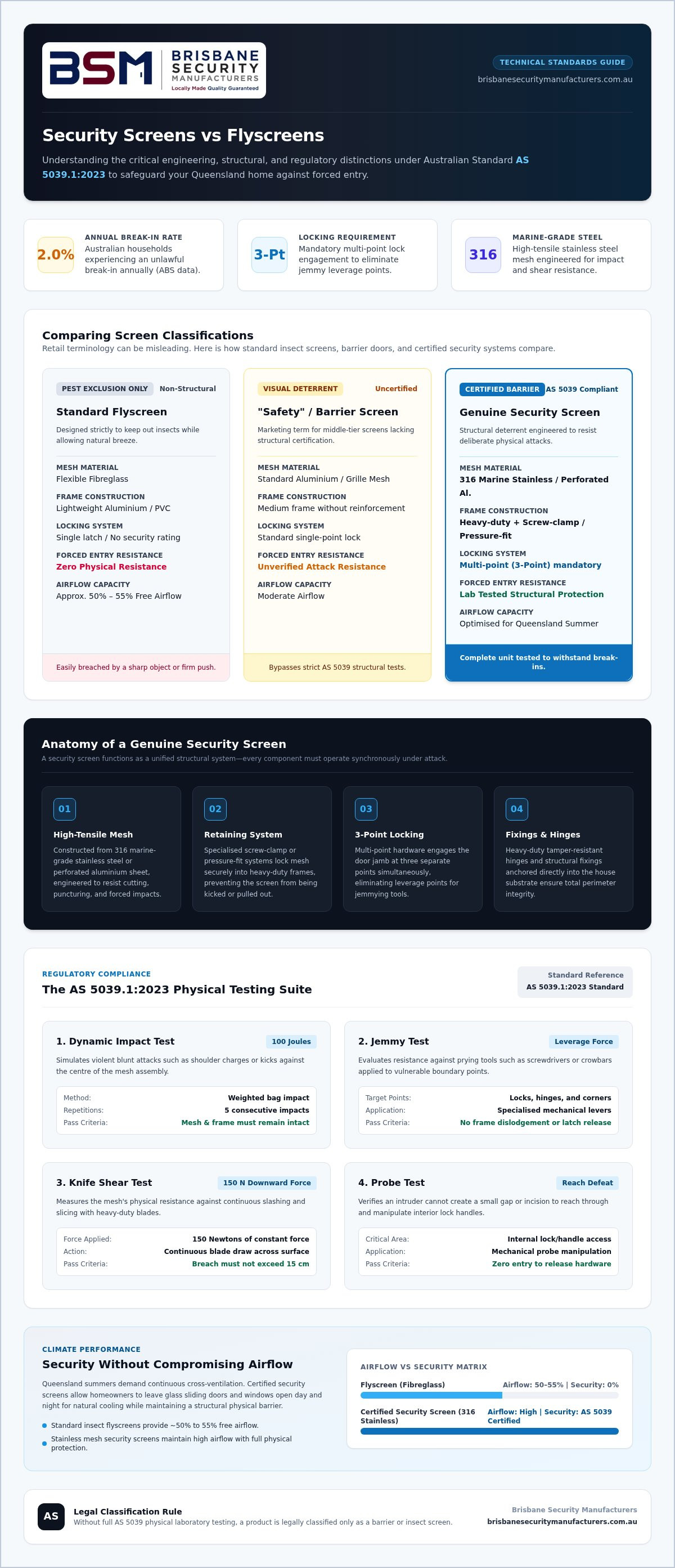
Homeowners often use these terms interchangeably, but the functional gap between the two is significant. A flyscreen is a barrier against pests; a security screen is a structural deterrent against forced entry. In the security screen vs flyscreen comparison, the primary differentiator is the ability to withstand a deliberate physical attack. Many retailers offer "safety screens" or "barrier screens" as a middle-tier option. These products look like security screens but lack the reinforced engineering required for certification.
To better understand the physical differences between these materials, watch this technical comparison:
The Primary Purpose of Flyscreens
Flyscreens consist of lightweight aluminium or PVC frames paired with flexible fibreglass mesh. These standard window screens facilitate natural ventilation while excluding mosquitoes and flies. They allow roughly 50% to 55% free airflow, which is ideal for the Queensland climate. However, they offer zero resistance to physical force. A sharp object or a firm push easily breaches the mesh or dislodges the frame. Consequently, these products serve a purely utilitarian role in pest management rather than property protection.
What Makes a Screen a Security Screen?
A genuine security screen functions as a unified system where the frame, mesh, and hardware work together. The mesh is typically high-tensile 316 marine-grade stainless steel or perforated aluminium sheet. Manufacturers use specialised screw-clamp or pressure-fit systems to lock the mesh into a heavy-duty frame. This prevents the mesh from being pulled out or kicked through under pressure. The structural integrity is maintained through the strength of the assembly rather than the mesh alone.
The locking mechanism is another critical component. Unlike standard screens, security versions require multi-point locking systems. These systems engage the door frame at three separate points to prevent prying or jemmying. This configuration, combined with tamper-resistant hinges and fixings into the house substrate, ensures the screen remains a secure barrier during a break-in attempt. Choosing between a security screen vs flyscreen depends on whether your priority is basic insect exclusion or physical property protection. Every component must be tested as a complete unit to provide the structural integrity necessary for residential protection.
Australian Standards: AS 5039 and Your Protection
In Australia, the distinction in the security screen vs flyscreen market is governed by strict regulatory requirements. AS 5039 is the primary Australian Standard that defines what constitutes a genuine security product. This standard ensures that every component has survived rigorous physical laboratory testing. AS 5039 serves as the legal benchmark for security screens in Australia. Products marketed as "security-style" or "safety doors" often bypass these tests. Without certification, a screen is legally classified as a barrier or insect screen, regardless of its visual appearance.
The Five Critical Security Tests
To achieve compliance with the AS 5039.1:2023 standard, a complete screen unit must pass a suite of physical challenges. The Dynamic Impact Test involves five impacts from a weighted bag delivering 100 Joules of energy. This simulates a kick or shoulder charge against the mesh. The Jemmy Test uses specialised levers to apply pressure to locks, hinges, and corners. If the frame or lock fails under this prying force, the product cannot be sold as a security screen. These tests confirm the structural integrity of the entire assembly under duress.
Knife Shear and Probe Testing Explained
The Knife Shear Test assesses the resistance of the mesh itself. A heavy-duty blade is drawn across the surface with 150 N of downward force. High-tensile 316 marine-grade stainless steel is designed to resist this cutting action without allowing a breach larger than 15 cm. Additionally, the Probe Test ensures an intruder cannot create a small opening to reach internal locks or handles. These tests are vital for ground-floor entries where cutting or reaching through mesh is a common tactic for intruders.
A certified product only provides protection if it's installed correctly. The new AS 5039.2:2024 standard governs installation compliance, ensuring the screen is fixed securely to the building substrate. DIY kits often fail here because they lack the tamper-proof fixings and precise tolerances required for certification. Professional installers ensure the three-point locks and reinforced frames function as intended. You can verify your property's compliance by working with professional local installers who understand these technical requirements. Choosing a product that meets these standards guarantees that your investment provides more than just a visual deterrent.
Comparing Performance: Security, Airflow, and Durability
When evaluating the security screen vs flyscreen choice, homeowners must balance physical protection with environmental performance. Standard fibreglass flyscreens allow approximately 50% to 55% free airflow, which is optimal for cooling a home. Modern woven 316 marine-grade stainless steel security mesh provides a comparable experience, allowing roughly 40% to 46% airflow. This slight reduction is often imperceptible, yet it offers the structural resistance recommended in official home and residential security guidance. High-tensile stainless steel also provides superior optical clarity, appearing almost invisible from a distance compared to the thicker, darker appearance of some traditional insect screens.
Mesh Types and Insect Protection
Insect protection remains a priority in regional Queensland centres. Standard mesh excludes most pests, but coastal properties often require micro-mesh to block smaller midges. Security mesh handles this effectively without significantly blocking natural light. For those seeking additional utility, restricted-vision or "one-way" mesh provides privacy from the outside while allowing residents to see out clearly. This is a common choice for front entry doors where visibility control is required alongside forced-entry resistance. Perforated aluminium sheet security doors allow lower airflow, approximately 25% to 35%, but offer enhanced visual privacy for ground-floor installations.
Durability in the Queensland Climate
The Queensland climate presents specific challenges, particularly regarding salt spray and UV exposure. 316 marine-grade stainless steel is the industry benchmark for corrosion resistance in coastal areas like the Sunshine Coast. In contrast, standard aluminium flyscreen frames can suffer from pitting and oxidation if not maintained correctly. High-quality security screens utilise advanced powder-coating to protect the structural integrity of the assembly over time. Regular maintenance involves washing the mesh with a mild detergent to remove salt and dust, which prevents the build-up of corrosive elements.
Selecting the right material depends on your property's proximity to the ocean and your specific ventilation needs. Learning How to choose security screens for your home involves assessing these material differences against your local environment. While standard flyscreens are cost-effective for high-level windows, ground-floor openings require the durability of a certified system to withstand both the weather and potential intruders. Investing in the correct mesh type ensures your home remains cool and protected without compromising on long-term structural health.
Which Option Suits Your Property and Budget?
Deciding between a security screen vs flyscreen requires a clear assessment of your property's specific vulnerabilities. Ground floor entry points and accessible windows are high-risk zones that necessitate the structural integrity of certified products. Conversely, upper-storey windows with no external access may only require insect protection. Many Brisbane homeowners opt for a mixed-product strategy. They install high-tensile security screens on main thoroughfares while using standard flyscreens for high-level ventilation. This approach manages the budget while maintaining a robust perimeter.
Evaluating Your Security Needs
Identifying vulnerable entry points is the first step in property protection. Sliding doors and louvre windows are often targeted because standard latches are easily bypassed. Installing hinged security doors for Queensland homes provides a physical barrier that deters opportunistic crime. For those in multi-storey builds, barrier screens serve as a middle ground. They meet National Construction Code requirements for child fall prevention without the full cost of an AS 5039-compliant security screen. These barriers are essential for windows where the potential fall is 2 metres or more.
Factoring in Long-Term Value
The financial comparison between these products involves more than just the initial purchase price. A standard flyscreen typically has a lifespan of 3 to 5 years before the fibreglass mesh becomes brittle or tears. A custom-manufactured security screen offers a lifespan of 10 to 20 years. These screens also add tangible value to the property and may lead to reduced home insurance premiums with certain providers. A security screen is a one-time investment in peace of mind. To ensure your home meets these standards, connect with professional trade installers for a custom manufacturing solution that fits your specific risk profile.
Professional Installation and Custom Manufacturing
The choice in the security screen vs flyscreen debate is often compromised by improper installation. Off-the-shelf "security-style" doors and DIY kits available at hardware retailers rarely provide the protection they claim. These products are manufactured in standard sizes that do not account for out-of-square door jambs or settling in the building's foundation. A security screen only functions as intended when it is integrated perfectly with the host frame. Off-the-shelf options often rely on plastic splines or inferior rivets that fail under the dynamic impact tests defined in Australian Standards.
The Benefits of Custom-Made Screens
Custom manufacturing eliminates the structural vulnerabilities found in mass-produced barriers. Professional installers take precise measurements to ensure there are no gaps between the screen and the substrate. Even a small gap provides a leverage point for prying tools. Customisation also allows for the seamless integration of modern hardware, including smart locks and multi-point locking systems. This ensures the door remains functional and secure without requiring awkward modifications on-site. Furthermore, custom production enables exact colour matching. We provide frames that align with your existing window joinery and architectural style, maintaining the aesthetic value of your property while upgrading its security profile.
Connecting with Local Brisbane Installers
Brisbane Security Manufacturers serves as the bridge between high-quality manufacturing and professional local installation. We maintain a trade installer portal that connects residential and commercial clients with qualified professionals across Queensland. Our network covers major regional centres, including Brisbane, the Sunshine Coast, Moreton Bay, and Townsville. Using a professional facilitator ensures that your installer possesses the necessary licences and technical experience to meet AS 5039.2:2024 installation requirements.
The process is designed for efficiency and transparency. By registering your project through our portal, you gain access to a structured network of trade professionals who understand the specific needs of the Queensland environment. This methodical approach removes the guesswork from property protection. Your next step involves identifying the specific openings that require a security upgrade and requesting a professional assessment. This ensures that the final product is custom-manufactured to the exact specifications of your home, providing a reliable and durable barrier against both pests and intruders.
Securing Your Property with Certified Solutions
Choosing between a security screen vs flyscreen involves a clear distinction between pest management and structural protection. Standard insect screens facilitate airflow, but only certified security products provide the physical resistance necessary to deter intruders. Verifying compliance with AS 5039 ensures that every component, from the high-tensile mesh to the multi-point locks, functions as a unified system.
Brisbane Security Manufacturers connects homeowners with trade-qualified installers who specialise in custom-manufactured solutions. Our network serves Brisbane and regional Queensland, ensuring that every installation meets strict Australian Standards. Custom manufacturing eliminates the vulnerabilities associated with mass-produced kits, providing a perfect fit for any opening.
Professional installation remains the final step in ensuring your property is secure. You can Get a Professional Security Screen Quote in Brisbane to register your project for a technical assessment. We look forward to helping you achieve a higher standard of security for your Queensland home.
Frequently Asked Questions
Is a flyscreen considered a security screen in Australia?
No, a flyscreen is not a security screen in Australia. To carry the "security" label, a product must comply with the AS 5039.1:2023 standard. Standard flyscreens are engineered solely for insect exclusion and lack the structural integrity to withstand physical force. Genuine security screens undergo dynamic impact and jemmy testing to ensure they remain a viable barrier against intruders. Products without this certification are legally classified as barrier or insect screens.
Can a burglar cut through a security screen mesh?
Cutting through a certified security screen mesh is extremely difficult for a standard intruder. During the mandatory Knife Shear Test, the mesh must resist a heavy-duty blade drawn with 150 N of force. High-tensile 316 marine-grade stainless steel is specifically designed to resist slicing. While no material is completely indestructible, the time and effort required to breach a security screen vs flyscreen make it a highly effective deterrent for most residential properties.
Do security screens block airflow more than flyscreens?
Security screens allow for significant natural ventilation, though the rate is slightly lower than standard insect mesh. Woven 316 stainless steel security mesh typically facilitates 40% to 46% free airflow. In comparison, standard fibreglass flyscreens allow approximately 50% to 55%. This difference is often negligible in the Queensland heat. Perforated aluminium sheets offer lower airflow at 25% to 35% but provide increased visual privacy for ground-floor entries in Brisbane or Townsville.
What is the difference between a barrier screen and a security screen?
The primary difference is compliance with Australian Standards. A security screen must pass six laboratory tests defined in AS 5039.3:2023, including impact and jemmy tests. A barrier screen, often marketed as a "safety screen," looks similar but has not been certified to resist forced entry. Barrier screens are suitable for child fall prevention on upper storeys but don't provide the structural resistance required for ground-floor protection against burglars.
Are security screens worth the extra cost for a rental property?
Investing in security screens for a rental property is often a cost-effective long-term strategy. Unlike flyscreens that require replacement every 3 to 5 years, custom-manufactured security screens last between 10 and 20 years. They enhance tenant safety and can reduce the risk of property damage during break-in attempts. Many landlords in Brisbane and the Sunshine Coast find that these installations increase property value and appeal to safety-conscious tenants while potentially lowering insurance premiums.
What mesh is best for keeping midges out in Queensland?
Micro-mesh, often called midge mesh, is the most effective option for excluding smaller insects in coastal Queensland. While standard security mesh provides excellent general protection, specific perforated aluminium designs or finer woven meshes can be utilised to block midges. When choosing between a security screen vs flyscreen for coastal areas like Mackay or Cairns, ensure the aperture size is small enough to prevent midges from entering while still maintaining adequate airflow.
Do I need a security screen to meet insurance requirements?
Insurance requirements vary between providers, but many Australian insurers offer lower premiums for homes with certified security screens. Some policies may mandate specific security measures, such as deadlocks or AS 5039-compliant screens, to qualify for theft coverage. We recommend reviewing your Product Disclosure Statement (PDS) to determine if professional installation is required. Installing compliant screens ensures you meet the "reasonable care" clauses often found in residential and commercial insurance contracts.
Can I install a security screen myself to save money?
You cannot legally install a security screen yourself if you require it to be certified under Australian Standards. AS 5039.2:2024 governs the installation process, requiring specific tamper-proof fixings and precise tolerances. Brisbane Security Manufacturers doesn't sell DIY kits because structural integrity depends on a professional fit. Our network of trade-qualified installers across regional Queensland ensures that your custom-manufactured screen is fitted correctly to provide the maximum level of physical protection.

