

The most expensive security screen on the market is worthless if it fails to meet Australian Standards or corrodes within three years of installation. You likely understand that protecting a home requires more than just a sturdy looking door. However, with various mesh types and frame designs available, learning how to choose security screens that actually perform can be a technical challenge. Residents in Brisbane and the Sunshine Coast face the additional pressure of coastal salt spray, which can quickly degrade inferior materials.
This 2026 buying guide provides a structured approach to evaluating materials, testing standards, and installation methods so you can secure your property with confidence. We focus on the logistical facts of residential and commercial security. You'll find clear information on AS 5039 compliance, the differences between 316 marine-grade stainless steel and perforated aluminium, and what to expect during the professional quoting process. This ensures your investment provides long-term durability against both weather and intruders.
Key Takeaways
- Verify compliance with AS 5039:2008 to ensure your screens meet the legal and functional definitions of real security.
- Differentiate between 316 marine-grade and 304 structural-grade stainless steel to prevent corrosion in coastal areas like the Sunshine Coast.
- Learn how to choose security screens by examining critical hardware components such as triple-lock systems and reinforced frame corners.
- Understand the risks of non-compliant alternatives and why professional installation is required to maintain the structural integrity of the security system.
- Evaluate the benefits of custom-manufactured packages for large-scale commercial and residential development projects managed through digital portals.
Defining Real Protection: Australian Standards and Compliance
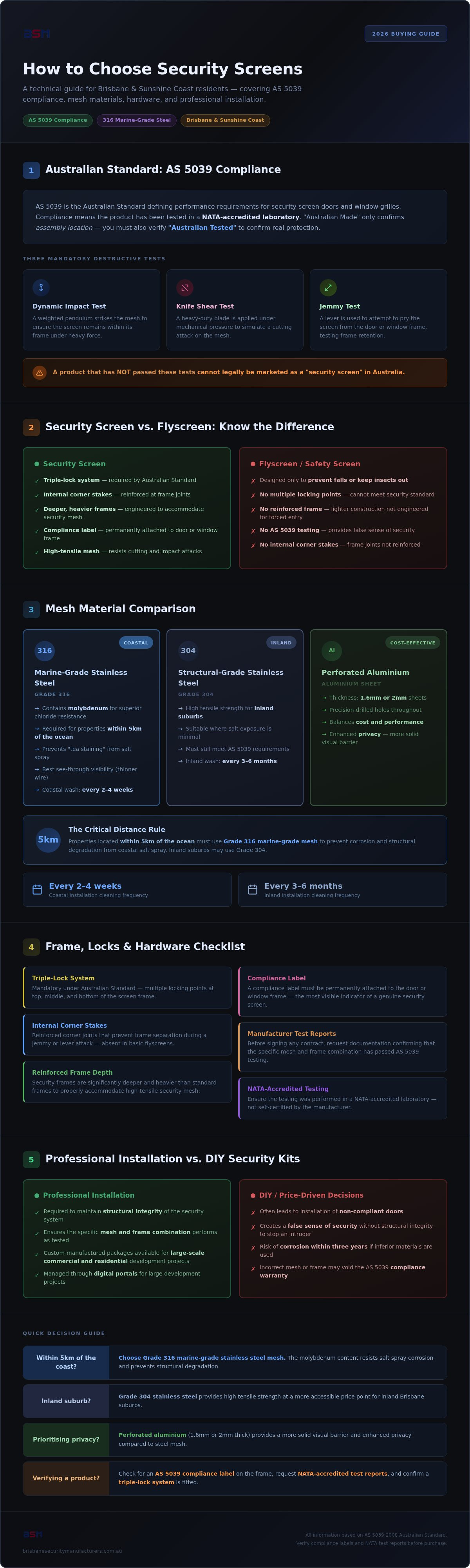
Understanding how to choose security screens begins with a technical assessment of Australian Standards. A screen that looks robust may not offer any actual protection against a determined intruder. In the Australian market, security is a measurable performance metric rather than an aesthetic quality. You must distinguish between products that merely act as a barrier and those engineered to withstand specific types of physical force.
What is AS 5039 Compliance?
AS 5039 is the Australian Standard that defines the performance requirements for security screen doors and window grilles. Compliance ensures that a product has undergone rigorous physical testing in NATA-accredited laboratories. While many products carry an "Australian Made" logo, this refers only to the location of assembly. To ensure true protection, you must verify that the product is also "Australian Tested" to meet the specific force requirements of the current 2026 standards.
Testing involves several destructive methods to simulate a home invasion. The Dynamic Impact Test uses a weighted pendulum to strike the mesh, ensuring the screen remains within its frame under heavy force. The Knife Shear Test subjects the mesh to a heavy-duty blade under mechanical pressure to simulate a cutting attack. Products must also pass the Jemmy Test, where a lever is used to attempt to pry the screen from the door or window frame. If a product has not passed these specific tests, it cannot legally be marketed as a "security screen" in Australia.
Security Screen vs. Flyscreen: The Trap
A common error when learning how to choose security screens is confusing a "safety screen" or "barrier door" with a "security screen". Safety screens are designed primarily to prevent falls from heights or to keep insects out. They do not possess the reinforced frames or high-tensile mesh required to withstand a targeted attack. Real security screens feature internal corner stakes and multiple locking points that are absent in basic flyscreens.
- Visual cues: Look for a compliance label permanently attached to the door or window frame.
- Locking hardware: Security screens require a triple-lock system to meet the Australian Standard.
- Frame construction: Standardised frames are significantly deeper and heavier to accommodate security mesh.
Before signing a contract, request the manufacturer's test reports. Professional manufacturers should provide documentation confirming that their specific mesh and frame combination has passed AS 5039. Price-driven decisions often lead to the installation of non-compliant doors that offer a false sense of security without the structural integrity to stop an intruder. Compliance is the only way to ensure the product performs as expected during a break-in attempt.
Comparing Security Screen Mesh: Stainless Steel vs. Aluminium
Selecting the right mesh material is a critical step in learning how to choose security screens for the Queensland climate. The decision depends largely on your property's proximity to the coast and your specific security requirements. High-tensile stainless steel and perforated aluminium each offer distinct logistical advantages regarding durability and visibility.
Stainless Steel Mesh: 316 vs. 304
Stainless steel mesh is categorised by its alloy composition. Grade 316 stainless steel contains molybdenum, which provides superior resistance to chloride-induced corrosion. Properties located within 5km of the ocean must use 316 marine-grade mesh to prevent "tea staining" and structural degradation caused by salt spray. In contrast, Grade 304 is a structural-grade material that offers high tensile strength for inland suburbs where salt exposure is minimal. Both materials must adhere to Australian building standards and compliance to ensure they function as intended during a physical attack.
Maintenance for these materials involves regular cleaning to remove salt and contaminants. Coastal installations require more frequent washing, often once every 2-4 weeks, while inland screens may only need attention every 3-6 months. Regular maintenance ensures the mesh remains compliant with long-term durability expectations.
Aluminium and Perforated Options
Perforated aluminium provides a durable alternative for homeowners seeking a balance between cost and performance. These screens typically use 1.6mm or 2mm thick aluminium sheets with precision-drilled holes. While stainless steel mesh offers the best "see-through" visibility due to its thinner wire diameter, perforated aluminium provides a more robust visual barrier that can enhance privacy. As you evaluate how to choose security screens, consider the following performance differences:
- Stainless Steel Mesh: Offers high open-area percentages, providing excellent clarity and maximum breeze.
- Perforated Aluminium: Provides a slightly lower open-area percentage, offering more shade and increased privacy from the street.
The integrity of aluminium screens relies heavily on high-quality powder-coating. This coating protects the metal from oxidation and allows for colour matching with existing window frames. Woven stainless steel generally allows for higher ventilation rates compared to perforated sheets, which is a significant factor in North QLD climates.
Galvanic Corrosion and Isolation
A technical risk often overlooked is galvanic corrosion. This occurs when two dissimilar metals, such as a stainless steel mesh and an aluminium frame, come into contact in a moist environment. Professional manufacturers prevent this by using a high-grade PVC pressure bead or insulator to separate the materials. Failure to isolate the mesh results in rapid frame failure and voids performance claims. You can view technical specifications for compliant systems through residential security services providers who prioritise material compatibility and long-term structural integrity.
Evaluating the Frame, Locks, and Hardware
Hardware components represent the structural foundation of any security system. While the mesh provides the physical barrier, the locking mechanism and frame determine if the screen remains functional during a forced entry attempt. Learning how to choose security screens requires a detailed inspection of these internal components, as they are often the first point of failure in non-compliant products.
A single-point lock is a significant vulnerability. It allows an intruder to use a lever to peel the top or bottom of the door away from the jamb. A triple-lock system engages the frame at three distinct points simultaneously. This distribution of force ensures the door remains anchored even if one section is under extreme pressure.
The Role of Three-Point Locking Systems
Three-point locking systems are a mandatory requirement for products seeking AS 5039 compliance. These systems engage the top, middle, and bottom of the door frame with a single action, such as turning a key or flicking an internal snib. For residential use, these locks are often keyed alike to existing house keys for efficiency. In commercial security services, hardware may include specialised panic bars or electronic strikes that integrate with wider access control systems.
Frame Integrity and Installation Substrates
The frame should consist of heavy-duty extruded aluminium. Many budget products use lightweight frames that lack the wall thickness needed to hold high-tensile mesh securely. Professional manufacturers use internal corner stakes to reinforce the frame's structure. This is superior to basic mitred corners, which can pull apart under the stress of a dynamic impact test. The frame must be rigid enough to maintain its shape when subjected to the jemmy tests defined by Australian Standards.
The strength of the fixings must match the strength of the mesh and frame. This includes using tamper-resistant stainless steel screws or rivets that cannot be easily drilled out or removed. The installation substrate also dictates the hardware used. Mounting a screen to a timber frame requires different fasteners than mounting to brickwork or steel sub-frames. Each substrate requires specific anchoring depths to ensure the entire assembly remains fixed during an attack.
Hardware evaluation must also include hinges and interlockers. Security hinges feature fixed pins that prevent an intruder from removing the door by knocking out the hinge pins. For sliding security doors, a heavy-duty interlocker is essential. This component hooks the back edge of the sliding door into the fixed jamb, preventing the door from being lifted off its tracks or pried open from the rear. These technical details ensure that the screen acts as a complete security system rather than just a mesh panel.
Professional Installation vs. DIY Security Kits
The effectiveness of a security screen depends on its integration with the building structure. A compliant product installed incorrectly loses its technical rating. When researching how to choose security screens, you must consider the installation method as part of the total security system. Retail DIY kits often bypass the rigorous requirements of Australian Standards, which can lead to structural failure during a forced entry.
The Compliance Gap in DIY
AS 5040 governs the installation process required for AS 5039 products. This standard specifies the type of fasteners, the spacing of fixings, and the maximum allowable gaps between the door and the frame. Common DIY errors include using standard timber screws instead of security-rated fasteners or failing to achieve a flush fit against the jamb. These mistakes compromise the structural integrity of the installation. A professional installation provides a warranty on both the product and the labour, ensuring the screen remains a functional security asset for its lifespan.
Older Brisbane homes often present logistical challenges due to foundation movement and "out-of-square" door frames. Retail kits assume a perfectly rectangular opening, which is rarely the case in established suburbs. Trade installers use custom-manufactured screens that account for these variances to ensure no gaps exist for jemmy tools to exploit. Insurance implications are also a factor. Many Australian insurance providers require proof of compliant security installation to honour specific policy claims. If a DIY-installed screen fails because it did not meet AS 5040, the provider may reject the claim on the basis that the property was not properly secured.
Finding a Qualified Brisbane Installer
Qualified installers understand the specific environmental and structural requirements of different Queensland regions. A contractor on the Sunshine Coast will prioritise corrosion resistance, while an installer in North QLD locations like Cairns or Moranbah will focus on high-velocity debris protection. You can find vetted trade professionals through an established manufacturer network. This system ensures the installer has the technical training to maintain product compliance.
Managing an installation project is streamlined through a specialised Trade Installer Portal. This digital system allows for precise tracking of measurements, manufacturing lead times, and installation schedules. It provides a transparent record of the project from the initial quote to the final compliance certificate. Using a professional installer through this network guarantees that your residential or commercial security services meet all regulatory benchmarks.
Selecting a Security Partner for Residential and Commercial Projects
The final stage of learning how to choose security screens involves selecting a partner capable of executing the project within professional parameters. Off-the-shelf products often fail to meet the specific structural requirements of Australian properties. Custom manufacturing ensures that every screen is built to the exact millimetre of the opening, which maintains the structural integrity required by AS 5039. A direct-from-manufacturer supply chain eliminates the delays and miscommunications associated with third-party retailers, providing a more reliable logistical path for both residential and commercial security services.
Working with a manufacturer-to-installer network provides a clear line of accountability. This structure ensures that the technical specifications discussed during the quoting phase are the same specifications delivered during installation. Centralised project management is particularly beneficial for commercial clients who require consistent security standards across multiple sites. This approach prioritises functional results and logistical transparency over aesthetic flair.
Solutions for Builders and Developers
Large-scale projects require a structured approach to procurement and logistics. Builders and developers benefit from contract-based security packages that align with construction timelines. This coordination ensures that security installations occur precisely when the building is ready, preventing delays in the handover process. Bulk pricing models for new builds allow developers to maintain high security standards while managing project budgets effectively.
The developer portal is a critical tool for streamlining project logistics. This digital platform allows project managers to organise quotes, track manufacturing status, and manage installer schedules across multiple locations in Brisbane or North QLD. Scaling security for a residential development or a commercial complex requires this level of digital oversight to ensure consistency and compliance across all units. It removes the administrative burden of manual tracking and provides a fast-paced, controlled experience for the project team.
Final Checklist for Your Security Screen Quote
A professional quote should be transparent and detailed. Before approving a contract, use the following checklist to verify the technical specifications of your chosen system:
- Mesh Verification: Confirm the mesh is either 316 marine-grade or 304 structural-grade stainless steel based on your property's proximity to the coast.
- Frame Construction: Verify the use of heavy-duty extruded aluminium frames with internal corner stakes rather than simple mitred corners.
- Locking Hardware: Ensure a triple-lock system from a reputable brand is included as a standard feature.
- Installation Standards: Confirm the quote specifies professional fitting by a qualified installer to AS 5040 standards.
- Warranty and Support: Check for local support and a manufacturer-backed warranty that covers both the product and the powder-coated finish.
If you're ready to secure your property or manage a large-scale development, register your project with Brisbane Security Manufacturers today to connect with our network of trade professionals and access our specialised project management portals.
Securing Your Queensland Property for the Long Term
Effective property protection relies on the integration of compliant materials and professional installation standards. Understanding how to choose security screens involves more than an aesthetic assessment; it requires a technical review of AS 5039 testing and material suitability for the Brisbane climate. Whether you prioritise 316 marine-grade stainless steel for coastal resistance or perforated aluminium for a commercial build, the structural integrity of the frame and locking system remains paramount.
Brisbane Security Manufacturers provides a direct connection to a local Queensland manufacturing and service network. Our specialised portals for developers and trade installers ensure logistical transparency and project efficiency from the initial quote to final installation. By choosing a partner that prioritises Australian Standards, you ensure your investment delivers durable, reliable protection against both environmental factors and forced entry. We invite you to get a professional security screen quote for your Brisbane project and experience a structured, no-nonsense approach to home and business security. Your property deserves a system engineered for performance.
Frequently Asked Questions
Do security screens really stop burglars?
Compliant security screens are highly effective at preventing forced entry by acting as both a visual deterrent and a physical barrier. Products tested to AS 5039 are engineered to withstand specific attack methods, including impact and cutting. While no system is entirely impenetrable, a professional installation significantly increases the time and effort required to breach a property. This delay often causes intruders to abandon the attempt or seek an easier target elsewhere.
What is the difference between 304 and 316 stainless steel mesh?
The primary difference lies in the chemical composition and corrosion resistance of the alloys. Grade 316 stainless steel contains molybdenum, which protects against chloride-induced corrosion in coastal regions like the Sunshine Coast or Brisbane bayside. Grade 304 lacks this addition but provides high tensile strength for inland suburbs with low salt exposure. Selecting the correct grade is a vital part of learning how to choose security screens that maintain their structural integrity over time.
Are black security screens harder to see through than lighter colours?
Black mesh is generally the easiest colour to see through because it absorbs light and minimises glare. Lighter colours, such as silver or cream, reflect more light into the eye, which can create a foggy visual effect and obscure the view. Most residential security services recommend black powder-coated mesh to maintain clear visibility of the outdoors while providing a high level of daytime privacy from the street.
How much does a professional security screen installation cost in Brisbane?
The cost of a professional installation depends on several logistical factors, including the dimensions of the opening, the chosen mesh material, and the complexity of the frame. Custom-manufactured products require precise measurements and specific hardware, such as triple-lock systems, which influence the final quote. We recommend registering your project through our online portal to receive an accurate assessment based on the specific technical requirements of your Brisbane or regional Queensland property.
Can I install security screens on sliding glass doors?
Security screens are frequently installed on sliding glass doors to provide ventilation without compromising safety. These installations require a heavy-duty interlocker, which is a component that hooks the back of the sliding screen into the fixed glass panel. This prevents the door from being lifted off its tracks or pried open from the rear. Professional manufacturers ensure that the sliding system remains compliant with AS 5039 while maintaining smooth operational movement.
Do I need to maintain or clean my security screens?
Regular maintenance is required to prevent the buildup of salt, dust, and environmental contaminants that can cause corrosion. In coastal areas within 5km of the ocean, screens should be cleaned every two to four weeks using a soft brush and mild detergent. Inland properties may only require cleaning every three to six months. Consistent maintenance is a technical requirement for preserving the appearance and structural integrity of both the mesh and the powder-coated frame.
Are there security screens that are pet-friendly?
High-tensile stainless steel mesh is an excellent choice for households with pets because it is resistant to scratching and clawing. Unlike standard flyscreens, which tear easily, security-grade mesh maintains its structural integrity under physical pressure from animals. For larger pets, some residential security services can integrate specialised pet doors into the screen. These additions must be professionally fitted to ensure the overall security rating of the door is not compromised during the modification process.
How do I know if a screen is actually compliant with Australian Standards?
Verification of compliance involves checking for a permanent label on the door or window frame that cites AS 5039. You should also request the manufacturer's test reports from a NATA-accredited laboratory to confirm the product has passed the dynamic impact and knife shear tests. Learning how to choose security screens involves vetting the installer's qualifications, as compliance is tied to both the product's manufacture and its professional installation according to AS 5040 guidelines.

